.svg)


Indian State Tamil Nadu's new government is putting investment, jobs, education, welfare and technology at the centre of its early agenda. The bigger question is whether political ambition can be converted into results that people can actually feel.
 Features Desk
A child sitting down for lunch at a government school does not see the state through the language of budgets, political speeches or election promises. The child sees a meal.
For a working mother, government can be something equally immediate. It can mean having enough time with a newborn without worrying about returning to work too soon. For a young graduate, it can mean whether a major investment announcement eventually becomes a company, a workplace and a salary. For a farmer, it can mean whether a government decision gives the family enough breathing space to face another difficult season.
These are ordinary moments, but they offer a useful way of looking at politics.
Governments are often judged through elections, announcements and headline figures. People, however, experience government differently. They experience it through schools, hospitals, roads, workplaces, farms, public offices and their own homes.
That is what makes the early direction of Tamil Nadu’s new government worth watching.
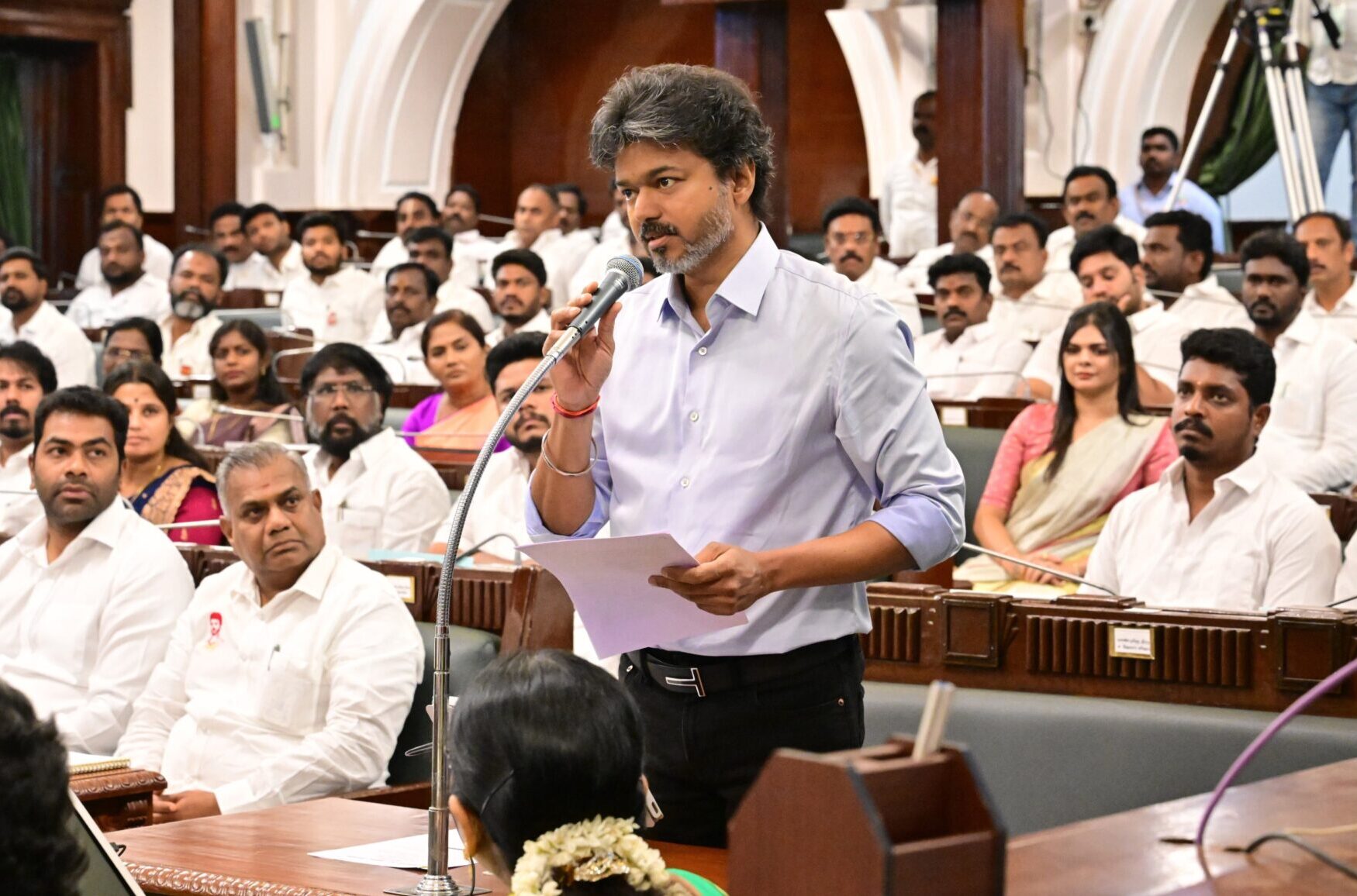
C. Joseph Vijay entered politics with something most politicians spend years trying to build: extraordinary public recognition. For much of his career, millions knew him as a film star. Now he is responsible for decisions that affect businesses, families, students and public institutions.
The transition is significant because popularity and governance are measured differently. A film can be judged when the credits roll. A government cannot. Its performance becomes visible slowly, through the quality of public services, economic opportunities and the confidence people have in the institutions around them.
For Vijay, the campaign was therefore only the beginning. The harder question is whether the government can turn public expectations into measurable results.
One of the clearest early signals has come from investment.
Tamil Nadu has announced 97 investment agreements worth ₹67,452 crore, with the projects projected to create more than 106,000 jobs. The proposed investments cover sectors including data centres, automobiles, renewable energy and critical engineering.
Those are impressive numbers. But numbers alone do not create prosperity.
For an investor, an agreement may represent the beginning of a major project. For a family, the question is much simpler: will there be a job at the end of it?
That distinction is important. An investment agreement is not yet a factory. A projected job is not yet a salary. The real test will come when these commitments become operating businesses, employment and long-term economic activity.
Tamil Nadu is also trying to position itself for industries that could shape the next decade, including artificial intelligence, data centres, advanced manufacturing and space-related industries. That ambition raises another question that is just as important as attracting investment: who will be ready to take the jobs that are created?
The connection between education and economic policy is often overlooked.
A factory can create jobs, but a school helps create the people who can take them. A technology company can bring investment, but the education system has to produce the engineers, technicians and professionals required to sustain that investment.
This is why development cannot be measured only by the number of companies that arrive. It also depends on whether people are prepared to participate in the economy those companies create.
The same principle can be seen in something far less glamorous than an investment agreement: a school meal.
Tamil Nadu has a long history of school nutrition programmes, and the system did not begin with the present government. But its continuing importance illustrates how public policy can influence lives in ways that rarely make headlines.
A child who is hungry may struggle to concentrate. Poor nutrition can affect health and learning. A meal at school can reduce pressure on a family while helping children remain engaged with education.
There is no large investment figure attached to that moment. Yet the consequences may last much longer than the political life of any government.

The same is true of policies affecting working mothers.
Tamil Nadu announced 365 days of maternity leave for women state government employees having a third child, extending the previous entitlement. The policy has also attracted debate about its wider consequences and its place within India’s demographic discussion.
But at an individual level, the question is straightforward. A woman has given birth. She needs time to recover. Her newborn needs care. Her family needs support. At the same time, she has a job and a career.
A government order may appear administrative on paper, but its consequences can reach directly into a family home.
That is one of the reasons public policy is more than a collection of files and figures. Decisions made inside government offices can determine how people live their everyday lives.
Women’s safety provides another test.
Governments can announce policies and programmes, but women experience safety outside the press conference. They experience it while travelling to work, waiting for transport, walking home, reporting a crime or approaching a police station.
The measure of success is therefore not simply how many initiatives are announced. It is whether women actually feel safer.
There is an economic dimension to this as well. A woman who does not feel safe travelling after dark may reject a job that requires late hours. A family concerned about safety may restrict a daughter’s education. An unsafe workplace may make it harder for employers to retain talented workers.
Safety is therefore not only a social issue. It can also influence whether people are able to participate fully in the economy.
The same human calculation exists in rural Tamil Nadu.
The government has highlighted farmer support, including reported relief measures involving eligible cooperative bank borrowers. For the administration, such a programme may be measured in crores. For a farmer, the questions are much more personal.
Can I plant again? Can I buy what I need for the next crop? Can I keep my land? Can I support my family? Can my children continue their education?
This is why public policy is ultimately measured at household level.
Budgets matter. Government statistics matter. Investment figures matter. But their importance comes from what they eventually produce in people’s lives.
There is also a less comfortable part of governing: getting things wrong.
A recent order concerning students’ participation in political protests was withdrawn after criticism. Supporters may view the withdrawal as evidence that the government was willing to listen. Critics may question why the decision was made in the first place.
Both questions are part of democratic accountability.
A government does not demonstrate strength by pretending that every decision is perfect. Sometimes strength is demonstrated by recognising a mistake and changing course.
That may be one of the most important tests of any administration. Institutions have to be capable not only of making decisions, but also of correcting them.
For all the attention surrounding Vijay personally, this is ultimately not a story about one politician.
A government cannot be run by political popularity alone. Investment needs administration. Education reform needs teachers and institutions. Welfare programmes need sustainable finances. Infrastructure needs planning and execution. Economic growth needs businesses that are willing to invest and people who are prepared to work in the industries being created.
Political will can provide the direction. It cannot do the work by itself.

That is where the next few years will matter.
The government can announce projects, but citizens will eventually ask whether those projects were completed. It can announce jobs, but young people will want to know whether those jobs actually exist. It can introduce welfare programmes, but future governments will have to determine whether those programmes remain financially sustainable.
The distance between an announcement and a result is where governments are truly tested.
That is also why the Tamil Nadu story is worth watching beyond the state itself.
The Maldives is a very different country, with a different population, geography, economic structure and fiscal reality. There is no reason to copy another government’s policies simply because they appear successful.
But the underlying question is universal.
What happens when a government begins every major decision by asking what it will actually produce for citizens several years from now?
What happens when attracting investment is linked to the jobs and skills that investment is expected to create? What happens when education is treated not only as a social responsibility but also as preparation for the economy ahead? What happens when welfare is designed around people’s real circumstances while governments remain conscious of what the state can afford?
These are not questions unique to Tamil Nadu.
They are questions for every government.
Political leaders have enormous influence over what receives attention, where public money is directed and how quickly institutions respond. But that influence becomes meaningful only when it produces something that citizens can see and feel.
Five years from now, people are unlikely to remember every government announcement.
They will remember whether their children had better opportunities. Whether they found work. Whether their businesses grew. Whether their families received support when they needed it. Whether women felt safer. Whether farmers became more secure. Whether promised investments actually arrived.
That is the real scoreboard.
Tamil Nadu’s experiment is still young. Its promises have not all become results, and its policies will inevitably face criticism, revision and failure along the way.
But that is precisely why it is worth following.
The most interesting question is not whether a former film star can become a successful Chief Minister.
It is whether political ambition can be converted into competent administration, sustainable economic growth and improvements that ordinary people can recognise in their own lives.
That is a much harder challenge than winning an election.
It is also a much more important one.
Because ultimately, the success of a government is not measured by how much power it holds.
It is measured by what it does with that power.