.svg)


Educational veteran Dr. Hassan Hameed has launched a historic 1,192-page English-Dhivehi dictionary containing over 120,000 words, developed over eight years of meticulous research.
 News Desk
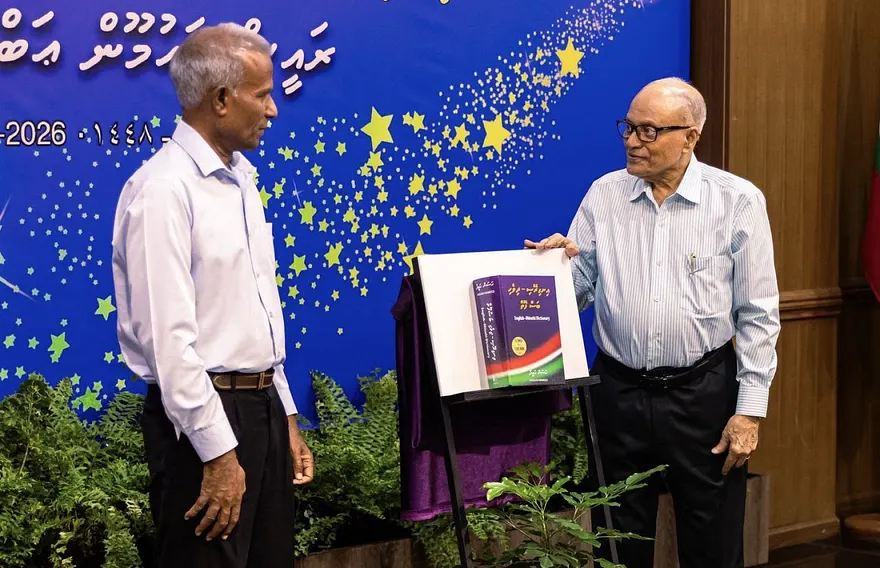
Former President Maumoon Abdul Gayoom unveils the new English-Dhivehi dictionary compiled by Dr. Hassan Hameed over eight years. — Photo: Maumoon Foundation
Educational veteran Dr. Hassan Hameed has launched a historic 1,192-page English-Dhivehi dictionary containing over 120,000 words, developed over eight years of meticulous research.
MALÉ: Renowned educational expert and former Chancellor of the Maldives National University (MNU), Dr. Hassan Hameed, launched a landmark English-Dhivehi dictionary at a special ceremony held at the university on Sunday night.
Former President Maumoon Abdul Gayoom unveiled the dictionary, describing the monumental publication as a national treasure due to its immense educational value and thorough research.
Praising the author’s work, former President Maumoon noted that compiling such a massive work requires years of dedicated effort, highlighting Dr. Hameed as an active and accomplished scholar.
Key features and details of the newly launched dictionary include:
Publication Specifications: The volume weighs over two kilograms, spans 1,192 pages, and features definitions for more than 120,000 words.
Eight-Year Compilation: Dr. Hameed spent eight years preparing the book, working from 6:00 a.m. to 9:00 p.m. on many days to complete the research.
Language Preservation: The work incorporates rare and traditional Dhivehi terms restored from historical texts and research into word origins.
Linguistic Adaptations: Where direct Dhivehi equivalents were unavailable, terms were adapted from phonetically compatible languages including Sinhala, Arabic, Urdu, and Japanese.
Target Audience: Designed for easy reference by students, general readers, researchers, and professional translators.
Addressing the ceremony, Dr. Hameed encouraged parents and educators to teach younger generations the value of speaking Dhivehi fluently without relying on English words, expressing hope that the new dictionary will help promote native vocabulary in daily speech.